



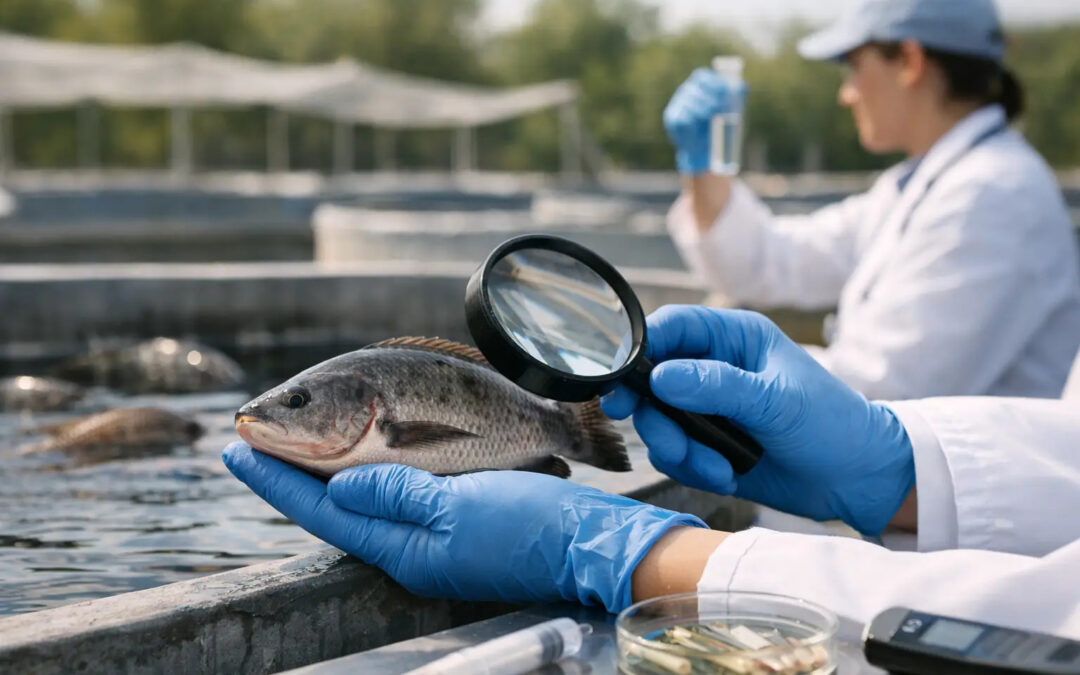
A fish rarely becomes seriously ill without offering earlier evidence. Appetite changes, isolation, flashing, rapid breathing, faded color, altered feces, and subtle shifts in swimming are not diagnoses. They are observations that require interpretation. Fish health training gives keepers, breeders, and aquaculture teams a disciplined way to turn those observations into timely, welfare-centered decisions.
The goal is not to memorize a long list of diseases or reach for medication at the first unusual sign. The goal is to understand what has changed, identify the most likely causes, test the environment, examine the fish carefully, and act in the right order. This approach prevents costly losses and avoids treatments that can add stress without solving the underlying problem.
Why Fish Health Training Starts With Observation
Many fish health problems are missed because normal behavior has never been properly defined. A keeper who only sees the aquarium during feeding may notice that a fish is not eating, but fail to see the increased respiratory effort or social withdrawal that began days earlier. On a farm, a mortality count may identify a problem after it has spread, while routine observations could have revealed a change in behavior much sooner.
Training develops observational discipline. This means watching fish before feeding, during feeding, and after disturbance. It means knowing the usual position in the water column, swimming pattern, feeding response, body condition, and social behavior of each species. In a production setting, it also means recording trends by tank, pond, cohort, or system rather than relying on memory.
A single symptom rarely tells the full story. Clamped fins may be linked to poor water quality, handling stress, parasitic irritation, bacterial disease, low temperature, aggression, or another cause entirely. The same is true for skin lesions, bloating, loss of color, and reduced appetite. Good diagnostics begin by resisting the urge to name a disease too quickly.
Build a Diagnostic Sequence Before You Treat
When fish appear unwell, the first question should not be, “What medicine should I use?” Ask instead, “What has changed, and what evidence supports the suspected cause?” A structured sequence keeps the investigation focused.
Start With the System
Water is the fish’s living environment, so the system must be evaluated before the fish is treated as an isolated patient. Measure temperature, dissolved oxygen where possible, pH, ammonia, nitrite, and relevant salinity or hardness values. Do not accept a single normal reading as proof that water quality is not involved. Consider fluctuations, recent maintenance, filter performance, stocking density, feeding rate, source-water changes, and whether test methods are reliable.
Low oxygen, for example, can produce gasping, lethargy, crowding near flow, and sudden mortality. Those signs may resemble infectious disease, but antibiotics or antiparasitic products will not correct an oxygen problem. In some cases, they may increase the risk by further reducing oxygen availability or placing additional strain on compromised fish.
Review the Timeline
The timeline often provides the strongest diagnostic clue. Determine when the first signs appeared, which fish were affected first, how rapidly the condition spread, and whether there were recent introductions, transport events, temperature shifts, dietary changes, spawning activity, or equipment failures.
A problem that begins immediately after new fish arrive calls for a different investigation than one that develops gradually in an overcrowded system. A sudden event affecting several species at once often points toward an environmental or toxic cause. A slowly progressing problem limited to one group may suggest species-specific susceptibility, chronic stress, parasites, or an emerging infection. These are not fixed rules, but they guide efficient investigation.
Examine the Fish, Not Just the Water
Once urgent environmental risks have been addressed, examine affected and unaffected fish closely. Compare body shape, gill movement, fins, skin, eyes, mouth, vent, scales, and feces. Observe whether lesions are raised, flat, pale, red, ulcerated, cotton-like, or associated with hemorrhage. Note whether the problem is external, internal, or primarily behavioral.
When practical and appropriate, microscopic examination of skin mucus, gill tissue, or fecal material can transform a vague suspicion into evidence. This is where professional-grade fish health education becomes especially valuable. Learning correct sampling, slide preparation, microscope use, and interpretation helps distinguish parasites from secondary infections, tissue damage, and harmless material that may look alarming to an untrained eye.
Prevention Is a Daily Management Practice
The most effective treatment is often the outbreak that never occurs. Prevention is not a single product or a quarantine tank used only when convenient. It is the daily management of stress, hygiene, nutrition, biosecurity, and environmental stability.
Quarantine is one of the clearest examples. New fish can carry pathogens without showing visible signs, particularly after transport stress. A proper quarantine period allows the fish to recover, be observed under stable conditions, and receive targeted intervention if evidence supports it. The exact duration and protocol depend on species, source, system design, and disease risk, but the principle remains constant: do not introduce unknown health status directly into an established population.
Nutrition deserves equal attention. Poor-quality feed, improper storage, overfeeding, and a diet mismatched to species or life stage can weaken performance and increase susceptibility to disease. Yet feeding less is not always the answer when illness appears. Fish that are already compromised may need careful adjustments based on water quality, digestive signs, temperature, and the specific condition. Training helps keepers recognize when feed is contributing to the problem and when appetite loss is simply a symptom of something deeper.
Biosecurity also needs to match the scale of the operation. A home aquarium keeper may focus on separate nets, clean hands, quarantine, and not sharing water between tanks. A breeder or aquaculture operation may require traffic control, equipment disinfection, cohort separation, mortality handling procedures, and written health records. The details differ, but both settings benefit from preventing pathogens from moving unnecessarily.
Avoid the Costly Habit of Random Medication
Broad, repeated medication is one of the most common responses to fish illness and one of the least reliable. It can damage beneficial biological filtration, reduce dissolved oxygen, irritate gill tissue, suppress appetite, create handling stress, and obscure the signs needed for an accurate diagnosis. For food fish, inappropriate use can also create residue, regulatory, and stewardship concerns.
This does not mean medication has no place. Correctly selected treatment can save fish and limit spread. The difference is evidence. A treatment plan should be based on the most likely diagnosis, the species involved, water conditions, disease stage, product safety, dose calculation, and the feasibility of treating the entire population versus individual fish.
There are situations where immediate action is required before a complete diagnosis is possible, particularly during severe oxygen depletion, toxic exposure, or rapidly escalating mortality. Even then, emergency measures should address the highest-probability risk first. Improve aeration, stabilize the environment, remove identifiable stressors, and collect information before changing several variables at once.
Turn Knowledge Into a Repeatable Routine
Fish health improves when training becomes a routine rather than something consulted only during a crisis. Keep concise records of water parameters, mortalities, treatments, new arrivals, feeding behavior, and unusual signs. Photographs and short videos can be useful when taken consistently, especially for comparing progression over time.
For serious keepers and professionals, a practical training program should build skills in stages: normal fish assessment, water and system evaluation, disease recognition, microscopic diagnostics, treatment planning, and prevention. Expert instruction from an experienced fish health biologist can shorten the learning curve because it explains not only what to look for, but why one finding matters more than another.
The central discipline is simple: observe early, investigate methodically, and treat only with a reason. Each careful assessment protects more than a single fish. It strengthens the health of the entire system and gives every future decision a better foundation.
Recent Comments