



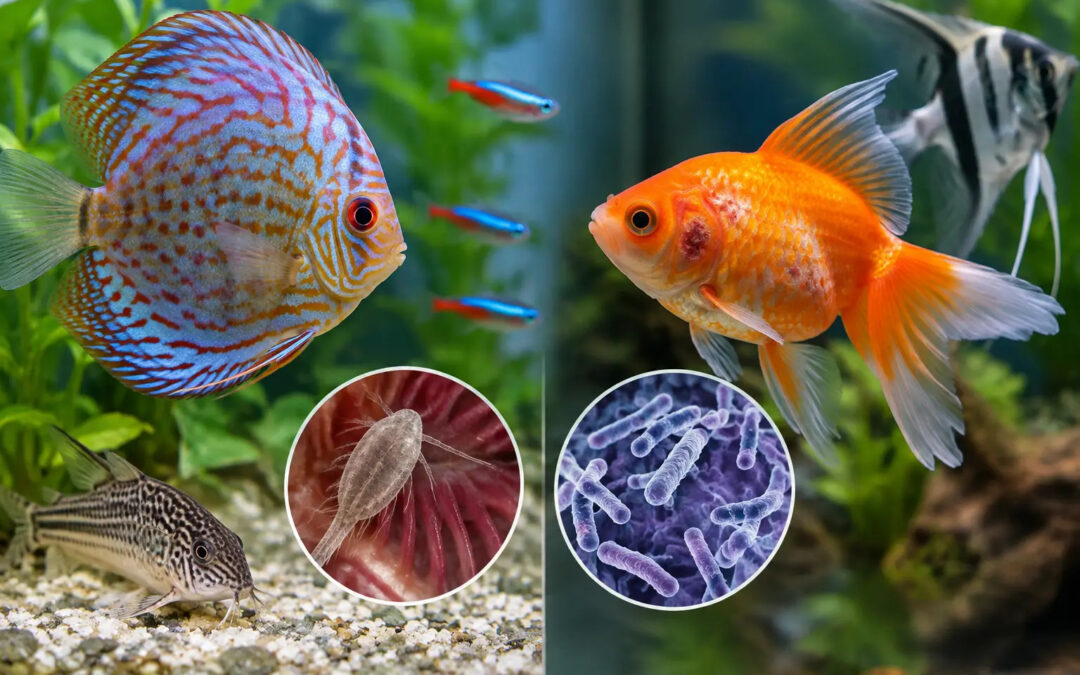
A fish that flashes against a rock, clamps its fins, and stops feeding has not given you a diagnosis. It has given you a reason to investigate. In fish health, parasites versus bacterial infections is not a simple choice between two symptom lists. Both can produce lethargy, poor appetite, skin changes, respiratory distress, and losses. The difference lies in what is causing the damage, how the disease develops, and what evidence is needed before treatment.
Treating the wrong category of disease wastes critical time, burdens already stressed fish, and can damage biological filtration or disrupt a carefully managed system. The disciplined approach is to begin with observation, confirm what can be confirmed, and correct the conditions that allowed disease to take hold.
Parasites Versus Bacterial Infections: The Core Difference
Parasites are organisms that live on or in a host and obtain a benefit at the host’s expense. In aquarium and aquaculture fish, they include protozoans such as Ichthyophthirius, Trichodina, Costia, and Chilodonella, as well as larger parasites such as monogenean flukes, anchor worms, and fish lice. They may affect the skin, gills, fins, internal organs, or intestinal tract.
Bacterial infections are caused by bacteria multiplying in or on the fish. Some bacteria are primary pathogens capable of causing disease in otherwise well-managed systems. Many others are opportunists. They become dangerous after transport stress, poor water quality, crowding, handling injury, aggression, parasitic damage, or nutritional weakness compromises the fish’s defenses.
This distinction matters because parasites are often directly observable with the right examination method. A skin scrape, gill biopsy, or fecal examination may reveal the organism responsible. Bacterial disease is more complex. External lesions may suggest a bacterial component, but a reliable diagnosis can require microscopy, culture, sensitivity testing, and an assessment of the entire environment.
A fish can have both. Heavy gill parasites can injure tissue and open the door to bacterial disease. A bacterial skin infection can weaken the fish and make it more vulnerable to parasites already present at low levels. This is why a single visible lesion should not automatically determine the treatment.
Start With the Pattern, Not the Medication
Before reaching for a treatment, establish the pattern of disease. Ask when the signs began, which fish are affected, whether new fish or plants were introduced, and whether the problem appeared after a temperature shift, equipment failure, water change, move, spawning event, or shipment.
Parasites often spread through a population in a recognizable way. Several fish may flash, produce excess mucus, clamp fins, isolate, or breathe rapidly. The exact pattern depends on the parasite and the tissues it targets. Gill parasites may cause rapid opercular movement, hanging near water flow, piping at the surface, or sudden unexplained deaths with few external marks. External protozoans can create a gray-blue film, cloudy patches, fine white spots, or irritation that causes flashing.
Bacterial infections may appear as frayed fins, ulcers, red streaking, hemorrhages, swollen areas, cloudy eyes, abdominal enlargement, or erosion around the mouth. Yet these signs are not exclusive to bacteria. A red area can result from trauma, ammonia damage, parasites, viral disease, or secondary infection. Fin damage can be caused by aggression or poor water conditions before bacteria become involved.
Look for the sequence. Did the fish first show irritation and excess mucus, then develop sores? Parasites with secondary bacterial invasion become more likely. Did problems begin immediately after netting, transport, or a water-quality event, with skin lesions concentrated where fish were injured? Stress and opportunistic bacteria deserve close attention. Pattern recognition guides the examination. It does not replace it.
The Most Useful Diagnostic Evidence
Water testing belongs at the beginning of every disease investigation. Measure temperature, dissolved oxygen where possible, pH, ammonia, nitrite, nitrate, and the parameters relevant to the species and system. Test the source water when appropriate. A disease treatment cannot compensate for ammonia exposure, low oxygen, unstable temperature, or severe organic loading.
Next, inspect the fish carefully under good lighting. Observe respiration before disturbing the animal. Count gill movements over a fixed interval if rapid breathing is suspected. Note body condition, coloration, fin posture, mucus production, ulcers, raised scales, feces, and the location of any lesions. Compare affected fish with apparently normal fish from the same system.
For suspected parasites, microscopy is often the decisive step. A properly collected skin mucus sample, fin clip, gill sample, or fresh fecal sample can identify many common parasites quickly. Technique matters. Excess pressure on the cover slip, an old sample, a dry preparation, or sampling only the center of a lesion can produce misleading results. Examine more than one fish when population-level disease is suspected.
For suspected bacterial disease, microscopy can still provide useful clues, especially from fresh lesions, but it rarely identifies the precise bacterial species with certainty. Culture and sensitivity testing are the stronger tools when valuable fish, recurring outbreaks, significant mortalities, or aquaculture production are involved. They help distinguish a targeted treatment plan from repeated empirical medication.
Why Symptoms Alone Commonly Mislead Keepers
White spots are strongly associated with ich, but not every white mark is ich. Breeding tubercles, trapped air bubbles, lymphocystis-like growths, mineral deposits, and injuries can all be mistaken for parasites. Likewise, an ulcer is often called a bacterial infection, even when the underlying cause is a parasite, an attack by a tankmate, or water-quality damage.
Respiratory distress is another frequent diagnostic trap. Rapid breathing can occur with gill parasites, bacterial gill disease, ammonia or nitrite exposure, low dissolved oxygen, temperature stress, toxins, and advanced systemic illness. Adding medication without checking water quality may worsen oxygen demand and increase losses.
A treatment response is not always proof of diagnosis either. A fish may improve because water was changed during treatment, because handling was reduced, or because the disease cycle changed naturally. Conversely, a correct treatment may seem ineffective if the product was underdosed, degraded, removed by filtration media, applied for too short a duration, or used against a life stage it does not affect.
Build a Safer Response Plan
The first priority is stabilization. Improve oxygenation, verify water quality, remove obvious sources of stress, and reduce unnecessary handling. Isolate affected fish when practical, but remember that a contagious parasite may already be present in the main system. Moving only visibly sick fish does not automatically protect the remaining population.
Then choose the least speculative next step. If microscopy identifies a parasite, use a treatment known to be effective for that parasite, at a dose and duration appropriate for the species, life stage, water conditions, and system type. Some fish, especially scaleless species, young fish, and sensitive ornamental varieties, require additional caution. Treatment that is acceptable in one system may be unsafe in another.
If bacterial disease is suspected but unconfirmed, focus on supportive conditions and obtain better diagnostic evidence before using antibiotics whenever possible. Indiscriminate antibiotic use can select for resistant bacteria, disturb filtration, mask the real cause, and complicate later treatment. A serious ulcer outbreak, septicemia signs, or repeated mortality event warrants professional diagnostic support rather than trial-and-error dosing.
Do not treat a display tank simply because one fish has a vague symptom. On the other hand, do not dismiss a developing population problem because only one fish is visibly affected. The correct decision depends on the organism suspected, the number of fish involved, the life cycle of the pathogen, and the biosecurity risks of the system.
Prevention Is the Most Effective Treatment Strategy
Quarantine is not merely a waiting period. It is a period of observation, stabilization, and, when indicated, diagnostic testing. New fish should be evaluated for behavior, appetite, respiration, feces, skin condition, and external parasites before they enter an established collection or production unit.
Good prevention also means avoiding chronic stressors: unstable water parameters, overcrowding, incompatible species, poor nutrition, inadequate filtration, rough handling, and neglected maintenance. These factors do not create every disease, but they make disease expression more likely and recovery less likely.
Keep records. Document arrivals, mortalities, water results, observed signs, microscope findings, and treatments used. Over time, records reveal patterns that memory misses. They also prevent a common mistake: repeating a treatment that failed last time because the original diagnosis was never established.
The best fish health decisions are usually made before the medication cabinet is opened. Train your eye to see patterns, train your hands to collect quality samples, and let evidence determine the next step. That discipline protects individual fish, preserves valuable populations, and turns each disease event into knowledge that strengthens the entire system.
Recent Comments