



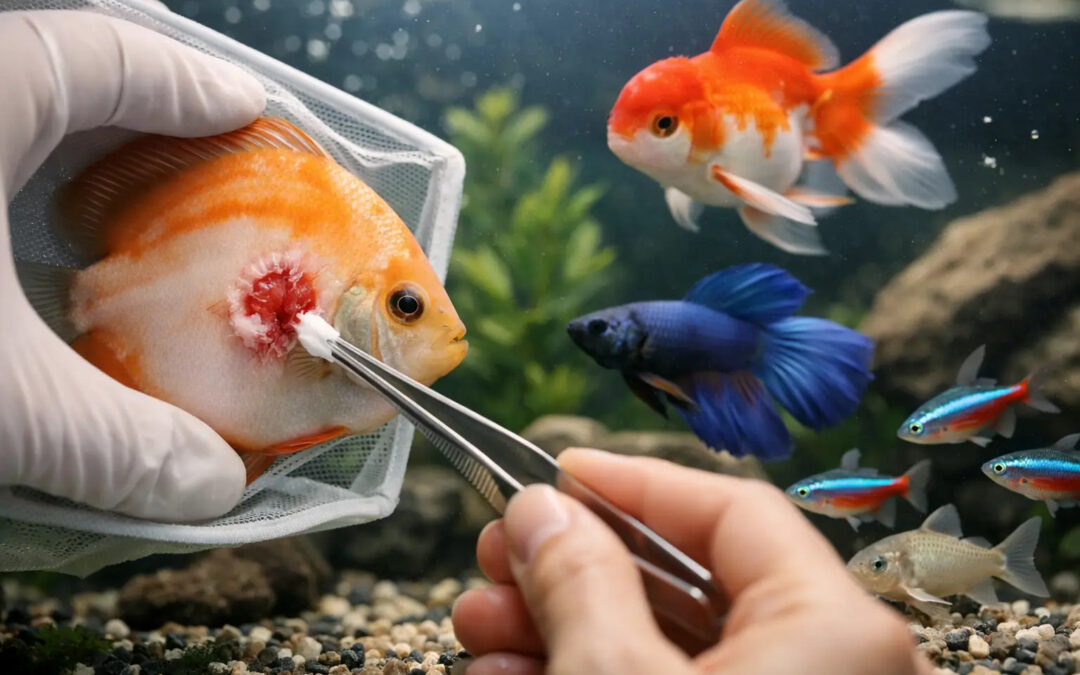
A fish with an open ulcer is not simply a fish with a skin problem. The wound may be the visible endpoint of a water-quality failure, aggression, parasite damage, nutritional weakness, or systemic infection. Effective fish ulcer wound care therefore starts before any medication is chosen: stabilize the fish, assess the environment, and determine why the protective barrier failed.
An ulcer can deteriorate quickly because fish live continuously in the same water that carries waste, microbes, and dissolved irritants. The goal is not merely to make the lesion look better. The goal is to stop tissue loss, reduce the microbial challenge, restore normal healing conditions, and prevent the next fish from developing the same problem.
Recognize a True Ulcer Before Treating It
An ulcer is a loss of skin tissue that may expose pale muscle, appear red or hemorrhagic, or develop a depressed center with ragged edges. It is different from a superficial scrape, a raised cyst, a cottony fungal growth, or a cluster of white spots. Early ulcers may begin as a discolored patch, missing scales, localized redness, or a small area of lifted skin.
Location provides useful clues, but not a final diagnosis. A wound on the flank may follow chasing, net injury, or contact with sharp décor. Ulcers around the mouth can occur after abrasion, poor water conditions, or infection. Lesions near the tail base and along the lateral line may be associated with systemic bacterial disease, parasites, or repeated environmental stress.
Observe the whole fish, not only the wound. Loss of appetite, clamped fins, rapid breathing, darkened color, isolation, flashing, frayed fins, abdominal swelling, or multiple lesions change the level of concern. A single fresh injury on an otherwise active fish requires a different response than several fish with reddened skin and declining behavior.
Fish Ulcer Wound Care Begins With Triage
First, test the water in the affected system. Check temperature, ammonia, nitrite, nitrate, pH, and oxygenation. Ammonia and nitrite should be zero. A measurable ammonia or nitrite reading is an urgent husbandry problem, because both compounds damage gills and skin while placing an already compromised fish under additional stress.
Perform an appropriately sized water change with temperature-matched, conditioned water. Remove uneaten food and organic debris, inspect filtration flow, and increase aeration when the fish shows rapid breathing or when treatment may reduce available oxygen. Do not make several dramatic changes at once unless water toxicity demands it. Stability supports recovery.
If the fish is being harassed, isolate it in a properly cycled hospital system when possible. The hospital system should match the main system’s basic water chemistry and temperature, provide gentle circulation, and include simple, clean shelter. Bare-bottom quarantine tanks make it easier to remove waste and monitor feces, feeding, and lesion progression.
Isolation is not automatically the right choice. Moving a severely weak fish can cause stress, and a communal outbreak means the main system also needs investigation. If several fish are affected, focus on the shared cause rather than assuming each ulcer is an isolated injury.
Determine What Opened the Door
Bacteria often colonize ulcerated tissue, but they are not always the initiating problem. Treating every lesion as a primary bacterial infection can create repeated failures. The fish may improve briefly, then relapse because the original stressor remains in place.
Start with a disciplined review of recent changes. Consider new arrivals, skipped maintenance, filter disruption, fluctuating temperature, crowding, spawning activity, aggression, shipping stress, poor feed storage, and changes in source water. Inspect nets, heaters, intake guards, rocks, ornaments, and tank seams for surfaces that can abrade skin.
Parasites deserve special attention when fish flash, produce excess mucus, clamp fins, or show lesions across multiple individuals. External parasites can damage the skin and create an entry point for secondary infection. Where equipment and experience are available, a skin scrape and gill examination provide far more useful evidence than treating by appearance alone.
A bacterial ulcer is more likely when there is progressive redness, tissue erosion, hemorrhage, fin involvement, lethargy, or multiple affected fish. However, lesions can also be linked to fungal colonization, viral disease, mycobacterial disease, or noninfectious trauma. The appearance of an ulcer is a clinical sign, not a complete diagnosis.
Protect the Wound Through Water and Handling
Clean, stable water is the foundation of wound repair. Maintain excellent filtration, remove solids promptly, avoid overfeeding, and use frequent partial water changes as testing indicates. The best schedule depends on stocking density, system volume, filtration capacity, and the level of waste present. Water changes are not a ritual. They are a tool for controlling the conditions surrounding damaged tissue.
Keep handling to a minimum. Repeated netting removes mucus, causes stress, and can enlarge a lesion. If examination or transfer is necessary, work efficiently with wet, smooth equipment and avoid pressure on the damaged area. Never squeeze an ulcer, scrape it, or attempt to remove tissue from an awake fish.
Topical wound treatments can be useful in selected cases, particularly for large, localized lesions in valuable ornamental fish. They also carry real risks. Improper restraint, excessive exposure to air, incorrect product concentration, and poor aftercare can harm the fish more than the original wound. Such procedures should be performed only by experienced handlers under a clear protocol, preferably with veterinary guidance for serious cases.
Use Medication as a Diagnostic Decision
Medication should follow a working diagnosis, not panic. When a fish has a deep, expanding, red, or hemorrhagic ulcer, systemic signs of illness, or no improvement after environmental correction, professional veterinary assessment is strongly advised. Culture and sensitivity testing may be warranted in recurring, high-value, or aquaculture cases, especially after previous treatment failures.
For suspected bacterial disease, treatment choice depends on the likely pathogen, whether the fish is still eating, water temperature, lesion severity, and applicable regulations. Medicated feed can be valuable when the fish is eating and the infection is systemic, while bath treatments may have a role for external disease. Neither method compensates for poor water quality or an unresolved parasite problem.
Avoid mixing medications simply because an ulcer looks severe. Combination treatment can complicate diagnosis, burden the fish, reduce oxygen, impair biological filtration, and make it difficult to know what helped or harmed. Follow product instructions precisely, remove chemical filtration only when the treatment protocol requires it, and monitor ammonia and nitrite throughout the course.
Do not stop a properly selected treatment at the first sign of improvement. Healing skin can look better before the underlying infection is controlled. Conversely, do not continue an ineffective treatment indefinitely. If the lesion expands, the fish stops eating, breathing worsens, or new fish become affected, reassess the diagnosis promptly.
Monitor Healing With Evidence, Not Memory
Take a clear photo from the same angle each day or every few days, depending on severity. Record water-test results, temperature, appetite, behavior, medication dates, and lesion changes. This simple record reveals whether the wound is truly shrinking or merely changing color.
Positive signs include a stable or smaller lesion, reduced redness, cleaner edges, return of normal appetite, normal swimming, and no new lesions. Darkening of a healing area can be normal pigmentation or scarring in some species, but it must be interpreted alongside behavior and wound size.
Warning signs include rapid expansion, a fuzzy or necrotic surface, bleeding, exposed deeper tissue, loss of balance, severe respiratory distress, or ulcers appearing on additional fish. These signs justify escalation rather than another round of guesswork.
Prevent the Next Ulcer
The strongest ulcer protocol is preventive. Quarantine new fish, avoid overcrowding, maintain stable water quality, provide species-appropriate nutrition, and design the system to reduce aggression and physical injury. Feed quality matters as much as feeding quantity. Old, improperly stored food can lose nutritional value and contribute to poor condition over time.
Routine observation is part of preventive medicine. A fish that eats more slowly, rubs against objects, holds its fins close, or develops a small patch of missing scales is offering an early warning. At that stage, careful testing and correction are often far more effective than waiting for a deep ulcer to demand treatment.
A healing wound is encouraging, but the real success is a system in which fish regain normal behavior, no additional lesions appear, and the conditions that caused the breakdown have been corrected for good.
Recent Comments